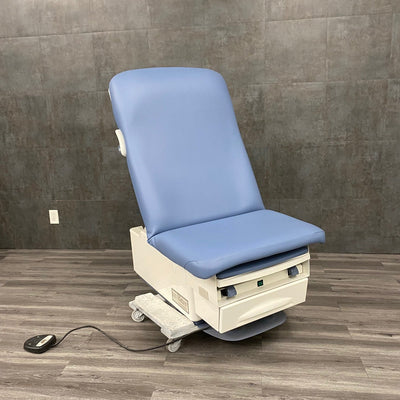


For most outpatient clinics, the honest answer is both. Certified refurbished medical equipment typically costs 30 to 70 percent less than new and performs identically for established, mechanical device categories such as exam tables, procedure chairs, autoclaves, and stretchers. New makes more sense when the device depends on current software, active OEM support, or a specification that recently changed.
That split is the part most buying guides skip. They hand you a pros and cons list and land on "it depends," which is true and useless. At Angelus Medical and Optical, our team in Gardena has been refurbishing and servicing clinic equipment since 1946, and the pattern we see is consistent: the right answer is decided line by line on your equipment list, not once for the whole purchase order.
This guide gives you the decision rule we use, category by category, so you can build a mixed list with confidence instead of guessing.
Quick Take: Buy refurbished when the device is mechanical, the technology is mature, and parts are still available. Buy new when the device depends on current firmware, an active OEM service contract, or a compliance specification that changed within the last few years.
What "Refurbished" Actually Means in Medical Equipment?

The words used and refurbished get treated as interchangeable in listings, and they are not. The difference is what was done to the device before it was resold, and the warranty is usually the honest signal.
There are four practical tiers in the secondary market:
- As-is or for parts. Sold with no testing and no warranty. Appropriate only if you are harvesting components or you have an in-house biomed team.
- Used. Functional at time of sale, minimal reconditioning, little or no warranty. Cosmetic and mechanical condition varies widely.
- Certified used. Inspected and tested, sold with a short warranty. The device works but has not been rebuilt.
- Refurbished. Restoring previously used equipment to a clean, reliable, and fully functional condition through inspection, repair, replacement of worn components, and performance testing. components replaced, tested against the original performance specification if necessary, and backed by a meaningful warranty.
At Angelus, that tiering is reflected directly in the coverage we publish on our certified and refurbished medical equipment listings: refurbished items carry 90 days parts and labor, certified and used items carry 15 to 30 days, and new items carry the manufacturer warranty.
When you compare quotes from two vendors, compare the tier and the warranty, not just the price. A "refurbished" unit sold with a 14 day warranty is a used unit with better marketing.
How the FDA Treats Refurbishing?

The FDA draws its regulatory line between servicing and remanufacturing, not between new and used. In its May 2024 final guidance, the agency defines servicing as repair or maintenance that returns a finished device to the safety and performance specifications established by the original manufacturer, while remanufacturing significantly changes the device's performance, safety specifications, or intended use.
Why this matters to you as a buyer: properly refurbished equipment is restored to the OEM specification, which keeps it inside the servicing lane. That is the standard your vendor should be able to describe, and document, on request.
Refurbished vs New Medical Equipment: The Cost Comparison

The headline number is real. Across the secondary market, certified refurbished devices commonly sell at 30 to 70 percent below comparable new pricing, with the widest gaps on high capital categories and the narrowest on low cost consumables and accessories.
The second saving is less obvious and often larger over a five year horizon: depreciation. New equipment absorbs its steepest value drop in the first year of ownership. A refurbished unit has already taken that hit, so it holds a larger share of its purchase price if you later resell, trade in, or need it appraised for a practice sale.
What refurbished does not save you is service cost. Both a new and a refurbished exam table need the same preventive maintenance and the same upholstery care. Build that into your comparison so the numbers stay honest.
Quick Take: Compare total cost of ownership over five years, not sticker price. Include purchase price, delivery and installation, warranty length, expected service calls, parts availability, and resale value. Refurbished usually wins categories where parts are plentiful and loses categories where the OEM has ended support.
The Real Deciding Factor Is What Fails First
Price tells you what you pay today. What fails first tells you what you pay for the next eight years. This is the framework our service team applies before we recommend refurbished on any given item.
Is the Failure Point Mechanical or Electronic?
Steel frames, actuators, casters, hinges, hydraulics, and upholstery are all fully restorable. A 12 year old exam table with a solid lift motor and new vinyl is functionally a new table. Sealed circuit boards, proprietary firmware, and locked calibration routines are a different story. If the OEM will not sell the board or unlock the service mode, the device has a hard end of life that no refurbisher can extend.
Are Parts Still Available?
Ask the vendor a direct question: can you still source replacement parts for this model, and for roughly how long. A device that is 40 percent cheaper but unsupported in two years is not a saving. Mature, widely deployed models are the safest refurbished buys precisely because the parts channel stays open for years.
Has the Compliance Specification Changed?
This is the variable almost every competing buying guide misses, and it is the one that creates real exposure.
If a device is subject to a standard that was revised recently, an older unit can arrive fully functional and still fail an inspection. The clearest current example is accessible medical diagnostic equipment. Under the HHS Section 504 rule, covered practices were required to have at least one accessible exam table and one accessible weight scale by July 8, 2026, with the accessible table meeting the low transfer height standard.
A refurbished table can absolutely satisfy that requirement. Nothing in the rule demands a new purchase. But the specific model has to meet the height and transfer specification, which means you check the spec sheet before you buy, not after delivery. We walk through the exact numbers in our guide to ADA exam table requirements, and our ADA compliant exam chairs and exam tables collection lists both new and refurbished units that meet it.
The same logic applies to calibration. If your state requires documented calibration on a device category, the unit needs a current certificate on arrival, refurbished or not. Practices in California can review the specifics in our overview of medical equipment calibration requirements.
Category by Category: Where Refurbished Wins

Applied to a typical outpatient equipment list, the framework above produces a fairly clear split.
| Equipment | Recommendation | Why |
|---|---|---|
| Exam tables and procedure chairs | Refurbished | Mechanical, long service life, upholstery and motors fully restorable |
| Stretchers and gurneys | Refurbished | Frame and hydraulics dominate; low technology turnover |
| Autoclaves and sterilizers | Refurbished | Refurbished works well. Both new and refurbish require proper maintenance |
| Patient monitors | Either | Depends on parameter needs, module support, and calibration status |
| EKG and ECG machines | Either | Buy new if EMR integration or your software is required |
| Electrosurgical units | Either | Mature technology; confirm output verification and accessory compatibility |
| Cabinets, carts, stools, casework | Refurbished | Essentially furniture; the savings are pure margin |
| Anything software dependent or under active OEM contract | New | Update entitlement and support usually follow the original purchaser |
You can browse the categories where we carry both options side by side, including exam tables and exam chairs, autoclaves and sterilizers, patient monitors, EKG machines, stretchers and gurneys, and electrosurgical units.
Exam Tables for Clinics: The Clearest Case for Refurbished
If you only apply this decision once, apply it here. Exam tables are the category where refurbished delivers the widest gap between what you pay and what you get.
A quality exam table is a welded steel frame, a lift mechanism, a set of drawers, and vinyl upholstery. Three of those four elements last decades. The fourth, the vinyl, is what makes a used table look tired, and it is the cheapest element to replace. Practices we work with are often surprised that a full exam table and procedure chair upholstery service costs a fraction of a new table and lets them pick a color that matches the rest of the room.
What to check on any refurbished table before you commit:
- Lift range and stability. Run it through the full travel. Listen for motor strain and watch for lateral play at full height.
- Transfer height, if the table is your accessible unit. Confirm the low position against the current standard rather than assuming.
- Upholstery seams and substrate. Surface wear is cosmetic and fixable. A compromised foam or wood substrate is a different repair.
- Drawer and stirrup hardware. Small parts are the most common source of post purchase annoyance.
- Footprint and door clearance. Measure the room before delivery day, especially for power tables.
Depending on your workflow, compare power exam tables against manual exam tables, and look at exam and procedure chairs if your rooms handle minor procedures. Our breakdown of the best exam table brands covers how the major manufacturers hold up over a long service life.
When You Should Buy New
Refurbished is not the default answer for everything. Buy new when any of the following apply:
- The device depends on current software or firmware. Update entitlements and security patches often do not transfer to a secondary owner.
- You need EMR or PACS integration on a current protocol. Older units may not speak the version your system expects.
- The technology is still changing fast. In a category with meaningful year over year capability gains, a three year old unit is a compromise, not a bargain.
- An active OEM service contract is a requirement of your accreditation body, payer, or lender.
- Parts support has ended. No refurbisher can source what no longer exists.
- The device is a critical single point of failure and you have no backup unit or same day service coverage.
The most expensive mistake in this category is not buying refurbished. It is buying a cheap unsupported unit and calling it refurbished because the listing said so.
Medical Equipment Cost Savings Beyond the Sticker Price
Two levers change the math more than most clinic owners expect, and neither depends on which condition you choose.
Section 179 Applies to Used Equipment
Equipment that is new to your business generally qualifies for Section 179 expensing even if it is not newly manufactured. For tax years beginning in 2026, the IRS sets the maximum Section 179 deduction at $2,560,000, reduced dollar for dollar once qualifying property placed in service exceeds $4,090,000.
For a small practice, the practical effect is that the tax treatment of a refurbished exam table and a new one is generally the same, while the cash outlay is not. Confirm eligibility, timing, and your specific situation with your CPA before you plan around it.
Financing Changes the Comparison
A lower purchase price also means a smaller monthly payment or a shorter term, which frees capital for staffing and buildout. If you are equipping a new location, review equipment financing options alongside the equipment itself rather than after you have chosen.
What to Verify Before You Buy Used Medical Equipment
Use this as your vendor checklist. A capable refurbisher will answer all of it without hesitation.
- Which tier is this? As-is, used, certified used, or refurbished. Get it in writing.
- What is the warranty, and does it cover parts and labor? Length alone is not the whole answer.
- Is a current calibration or performance verification certificate included? Relevant for monitors, EKG, autoclaves, centrifuges, exam lights, and diagnostic sets.
- Are parts still available for this model, and who supplies them.
- Who services it after the sale, and what is the typical response time in your area.
- Does it meet any specification your practice is required to satisfy, including accessibility and state calibration rules.
- What are the delivery, installation, and return terms? Read the return policy before you order, not after.
Compliance Note
This article is general purchasing guidance, not legal, tax, or regulatory advice. Accessibility rules, state calibration requirements, accreditation standards, and Section 179 eligibility vary by practice type, payer participation, and location. Verify your obligations with your compliance lead, accrediting body, applicable state agency, and CPA before making a purchasing decision. Device specific safety and performance questions should be directed to the manufacturer or a qualified service provider.
How Angelus Approaches Refurbished Equipment
Our refurbished items are tested and quality checked before they ship, and they carry 90 days parts and labor. Certified and used items carry 15 to 30 days. New items carry the manufacturer warranty. That structure exists so the tier you are buying is never ambiguous.
Because the work happens in house, we can also keep equipment running after the sale rather than handing you off. Practices use our medical equipment repair service for corrective work, preventive maintenance to keep sterilizers on schedule, and CDPH calibration certification for the device categories that require documented calibration. If you are valuing existing assets for a sale or refresh, our equipment appraisal service covers that as well.
You are also welcome to see equipment in person. Local pickup is available at our Gardena, California showroom, and long distance shipping is available for practices outside the area.
Frequently Asked Questions
Is Refurbished Medical Equipment Safe to Use in a Clinic?
Yes, when it is properly refurbished and documented. Refurbishment restores a device to the original manufacturer's safety and performance specification, which is the standard the FDA describes as servicing. Ask for the testing record and the warranty terms, and confirm any required calibration certificate is current on arrival.
How Much Can a Clinic Save by Buying Refurbished?
Certified refurbished equipment commonly sells at 30 to 70 percent below comparable new pricing. The savings are widest on higher capital and mechanical categories such as exam tables, procedure chairs, and stretchers, and narrowest on low cost accessories and consumables where the refurbishment labor is a larger share of the price.
What Is the Difference Between Used and Refurbished Medical Equipment?
Used equipment is resold in its current condition without reconditioning and little or no warranty. Refurbished equipment has been substantially restored to clean, reliable, and fully functional condition through inspection, repair, replacement of worn components, then sold with a meaningful warranty. The warranty length is usually the fastest way to tell the two apart.
Do Refurbished Exam Tables Meet ADA Accessibility Requirements?
They can. The accessibility rules govern the specification the equipment must meet, not whether it was purchased new. A refurbished table qualifies if the model meets the required transfer height and related criteria, so confirm the specification on the model you are considering before ordering.
Does Refurbished Medical Equipment Come With a Warranty?
Reputable vendors provide one. At Angelus, refurbished items carry 90 days parts and labor, certified and used items carry 15 to 30 days, and new items carry the manufacturer warranty. If a listing calls an item refurbished but offers only a token warranty, treat it as a used item.
Which Medical Equipment Should a Clinic Always Buy New?
Buy new when the device depends on current software or firmware, requires integration on a current EMR or imaging protocol, needs an active OEM service contract for accreditation or financing, or belongs to a category where the OEM has ended parts support for older models.
Can I Claim a Tax Deduction on Used Medical Equipment?
Generally yes. Section 179 applies to equipment that is new to your business, which includes used and refurbished purchases, subject to the annual limits and phase out thresholds the IRS publishes each year. Confirm your eligibility and timing with your CPA.
How Long Does Refurbished Medical Equipment Last?
Service life depends on the category rather than the purchase condition. Mechanical equipment such as exam tables, chairs, and cabinetry routinely serves well beyond a decade with routine maintenance and periodic upholstery work. Electronic devices are limited more by parts and software support than by wear.
What Should I Ask a Refurbished Medical Equipment Vendor?
Ask which tier the item is, what specifically was replaced or reconditioned, what the warranty covers, whether a current calibration certificate is included, whether parts are still available for the model, who services it after the sale, and what the delivery and return terms are.
Can Refurbished and New Equipment Be Mixed in the Same Clinic?
Yes, and for most practices that is the efficient answer. Buying refurbished on mature mechanical categories and new on software dependent or fast moving categories lets you allocate budget where it changes patient care rather than spreading it evenly across the equipment list.
Does Angelus Sell Both New and Refurbished Equipment?
Yes. We have supplied clinics with new and refurbished medical equipment since 1946, with in house repair, preventive maintenance, upholstery, and CDPH calibration certification available after the sale. You can view equipment at our Gardena, California showroom or arrange long distance shipping.
Choosing the Right Mix for Your Practice
Refurbished versus new is not a philosophy, it is a line item decision. Run each piece of equipment through three questions: is the failure point mechanical or electronic, are parts still available, and has the compliance specification changed. Refurbished usually wins on mechanical equipment with mature technology, and new usually wins where software, integration, or OEM support is doing the work.
For more than 75 years, Angelus Medical and Optical has helped clinics build that mix, with warranty backed refurbished equipment, new equipment where it makes sense, and the in house service team to keep both running. Contact our team or explore our exam tables and exam chairs collection to see what fits your rooms and your budget.